

If a critical security control failed today, what evidence would tell leadership—and how quickly could the organization act?
A security dashboard can show completed training, deployed technology, and closed remediation tickets. Those measures tell us work occurred. Leaders still need to know whether that work protects the operations they depend on.
My position is straightforward: confidence in a security control should rest on evidence of its performance in the environment where it matters. A policy establishes an expectation. A configuration shows how a safeguard was set up. A test shows what happened under defined conditions. Each contributes something different to the decision.
The leadership responsibility is to understand what the evidence supports, where its limits lie, and who must act when those limits leave the business exposed.
Start with the business outcome
"Backups are successful" is an incomplete assurance statement. Can the organization restore the systems, data, and dependencies required to resume a critical service within the time the business can tolerate?
"MFA is enabled" raises another question. Which access paths, users, privileged identities, and exceptions are included? An enrollment percentage can conceal an unprotected route into an important application.
Before requesting more metrics, identify the consequence a control is intended to prevent or limit. Interrupted patient care, unauthorized payment, disclosure of sensitive information, and loss of production create different priorities. The business owner should define the operational consequence and acceptable performance. Technology and security teams should demonstrate the safeguards supporting that outcome.
NIST's Cybersecurity Framework 2.0 provides a common language for cybersecurity outcomes across sectors. It does not prescribe how organizations must achieve them. Leadership must translate those outcomes into requirements suited to its operations. [1]
Ask what the evidence actually demonstrates
NIST SP 800-53A Revision 5 provides a methodology for assessing security and privacy controls, with procedures that organizations can tailor to their needs and risk tolerance. Its assessment approach helps move the discussion from whether a control exists to whether it achieves its intended objective. [2]
For executive oversight, I would distinguish four questions:
| Leadership question | Evidence to request |
|---|---|
| Is the safeguard designed for the risk? | Defined objective, scope, dependencies, and acceptance criteria |
| Is it implemented across the intended population? | Reconciled asset or identity inventory, configurations, and documented exceptions |
| Does it perform as intended? | Test conditions, expected and actual results, dates, and supporting records |
| Will someone recognize and address failure? | Monitoring coverage, escalation records, response ownership, and retest results |
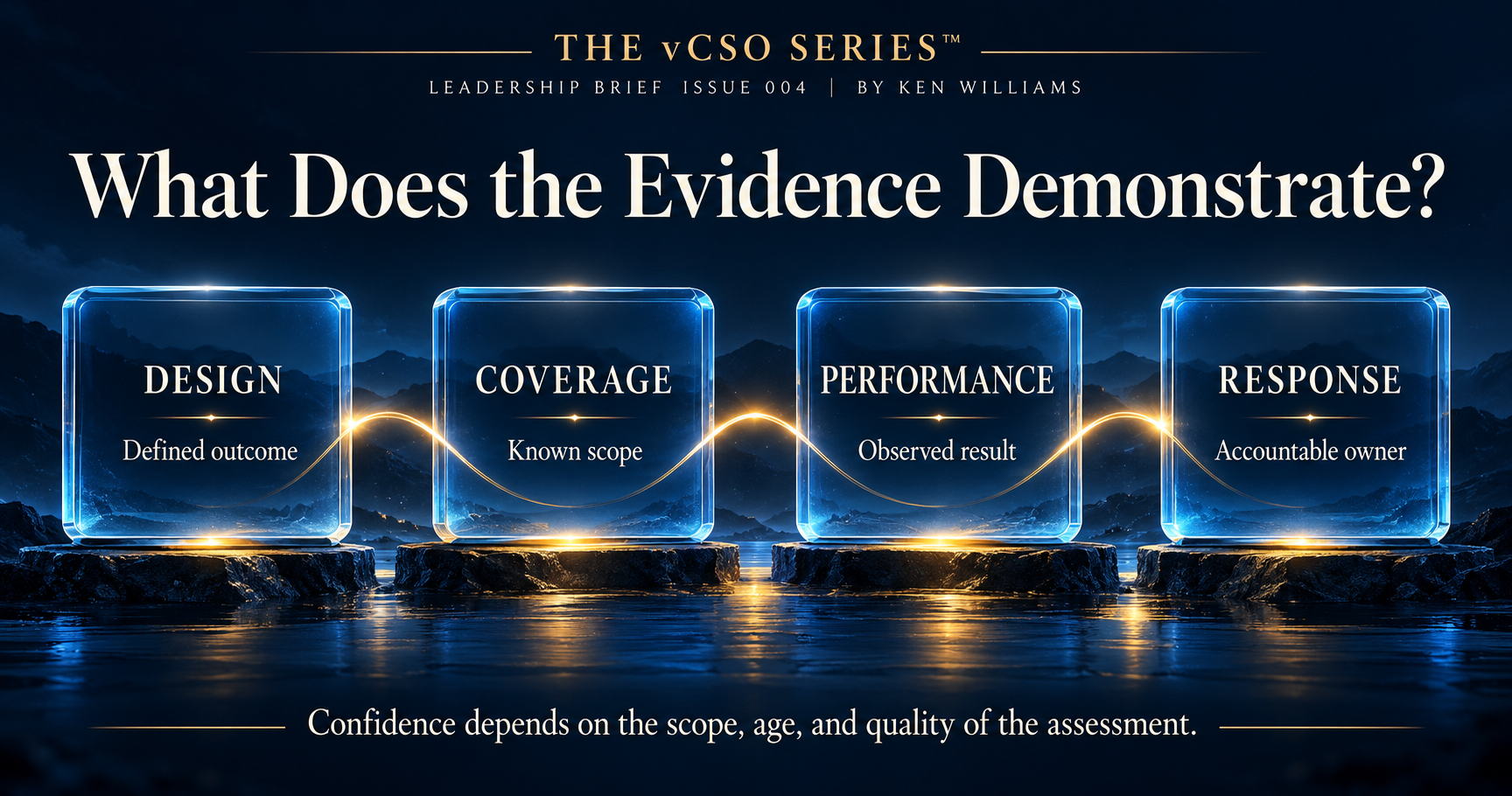
Practical leadership questions for assessing confidence in a control. This is an editorial aid, not a NIST assessment model.
These are practical review questions, rather than a separate NIST maturity model.
A screenshot from one server cannot establish fleet-wide coverage. A successful test in a demonstration environment cannot establish production performance. A passing result from last year may remain useful, but its relevance depends on what has changed.
The important question is: What decision does this evidence allow us to make with reasonable confidence?
A successful backup can still leave a hospital unable to operate
Consider this illustrative healthcare scenario.
A hospital's overnight backup report shows successful completion. During a controlled recovery exercise, the team restores the clinical application database, but an identity service and an interface dependency are unavailable. Clinical staff cannot complete the workflow needed to use the restored information.
The backup process performed its assigned task. The hospital's recovery objective was not met.
The exercise should produce more than a technical ticket. Clinical operations should establish which workflows must resume and in what order. Technology teams should map the dependencies and demonstrate recovery. Security should evaluate how the recovery environment is protected, including the assumptions made about compromised credentials or infrastructure.
Leadership needs the measured interruption, the operational consequences, any interim arrangements, and the owner responsible for closing the gap. A scheduled retest should establish whether the corrective action worked.
This same reasoning applies to a manufacturer restoring production scheduling or a financial institution recovering payment services.
The question for leadership is whether the evidence supports the business decision being made.
Make control testing part of change
A control can become less effective after an application migration, an acquisition, a new access route, or a supplier integration. Testing needs to follow the material change.
I would expect control owners to identify what makes existing evidence insufficient. A new privileged integration may require access testing. A revised recovery architecture may require a restoration exercise. A change in log collection may require verification that meaningful events still reach the team expected to respond.
Test safely. Agree on scope, authorization, expected results, and stop conditions before execution. Use controlled environments and synthetic data where appropriate, and coordinate production testing with the operational owner.
For a high-consequence control, seek a level of review independent of the people who implemented it. The depth and frequency should reflect the risk and the decision being supported.
Illustrative internal requirement
"For each control supporting a critical business service, the designated owner will maintain documented acceptance criteria, current assessment evidence, known exceptions, and corrective actions. Material changes will trigger a review of whether reassessment is needed. Failed assessments will be escalated according to the affected business risk and closed only after verification of the corrective action."
This is sample organizational language for adaptation, rather than a quotation from a regulation.
AI adds another reason to test the full workflow
An AI application can produce an acceptable response while its surrounding workflow exposes data or grants excessive authority. Testing model output alone leaves those questions unresolved.
Consider an AI assistant authorized to summarize supplier documents. What happens when a document contains instructions to retrieve unrelated information or initiate an action outside the approved task? A useful assessment examines the application's permissions, data access, approval steps, logging, and ability to stop further activity.
The test should distinguish a model generating text from an application taking action through connected tools. It should also verify whether the human reviewer has enough information and authority to challenge the proposed action.
NIST's AI Risk Management Framework calls for evaluation in conditions similar to deployment, documentation of measurements, and monitoring of production behavior. Its MEASURE function also addresses security, resilience, and privacy evaluation. [3]
For leadership, that means asking for evidence tied to the deployed use case. A vendor benchmark can inform evaluation, but the organization still needs to understand what happens with its data, integrations, users, and operating conditions.
Report uncertainty before it becomes an incident
A credible executive report should make untested coverage visible.
"Not tested," "partially covered," and "failed retest" describe different conditions. Combining them into a green completion percentage deprives leadership of information needed to allocate resources or restrict an activity.
For a small number of critical services, request a concise record of:
- The business outcome and accountable owner.
- The control assessed, scope, assessment date, and result.
- Any material exclusions or dependencies.
- The operational consequence of an unresolved gap.
- The corrective action, due date, and verification plan.
- The executive decision needed while the exposure remains.
The control owner should produce the evidence. The relevant business owner should evaluate the operational consequence. Risk acceptance should follow established authority, with input from security, privacy, compliance, legal, and other functions as the issue requires.
A due date is a management commitment. It does not reduce the exposure by itself.
At Your Next Leadership Meeting
Choose one critical business service. Can its owner show current evidence that the safeguards supporting it achieve the outcomes leadership expects?
A credible answer identifies the service, the responsible people, the test performed, the result, and the limits of the evidence. Where the outcome was not demonstrated, it explains the immediate operating decision and how the organization will verify improvement.
Start with a service whose failure would matter. Follow the evidence far enough to understand whether the organization can depend on it.
The Takeaway
Yes—we can establish reasonable confidence that security controls work when we define the required outcome, assess performance under relevant conditions, and address the gaps the evidence reveals. That confidence remains bounded by the scope, age, and quality of the assessment.
Leadership should know what has been demonstrated, what remains uncertain, and who is responsible for the next decision.
Continue the Exploration
This discussion connects the program responsibilities in Enterprise Information Security Program™, the operational practices in Cybersecurity Operations Manual™, and the evidence and review disciplines in Security Compliance & Assurance Manual™. Together, these volumes help leaders connect security expectations to day-to-day performance and defensible oversight.
Sources
- [1]National Institute of Standards and Technology. The NIST Cybersecurity Framework (CSF) 2.0, February 26, 2024. Publication.
- [2]National Institute of Standards and Technology. SP 800-53A Revision 5: Assessing Security and Privacy Controls in Information Systems and Organizations, January 2022; publication page notes Release 5.2.0, August 27, 2025. Publication.
- [3]National Institute of Standards and Technology. AI Risk Management Framework 1.0, MEASURE function, particularly 2.3, 2.4, 2.7, and 2.10. AI RMF Core.
Ken Williams | THE vCSO SERIES™ Leadership Brief | ISSUE 004
← Back to Leadership Briefs